
Overview
Supplement Hub, a D2C supplements brand selling through Amazon FBA, had plenty of data but struggled to extract actionable insights from it. With standard Amazon exports and no dedicated analytics infrastructure, their leadership team knew they were sitting on valuable customer intelligence they could not access.
MultiBase applied its DECIDE framework to analyze their raw Amazon data and built a comprehensive Customer Lifetime Value data story that revealed which customer segments drive the most long-term value and how first purchase choices predict future customer worth.
The Challenge
Like many fast-growing e-commerce brands, Supplement Hub faced a common but costly problem: they were data rich but insight poor.
Their situation included:
Data scattered across standard Amazon exports with no unified view of customer behavior or product performance patterns.
No visibility into Customer Lifetime Value despite having over 440,000 customers in their database. They knew customers were buying, but had no way to distinguish high-value customers from one-time purchasers.
Limited understanding of customer segmentation. Which product categories attracted the most valuable long-term customers? Which had retention problems? These questions remained unanswered.
Decision-making based on surface-level metrics like total revenue and order counts, missing the deeper patterns that could inform marketing spend and product strategy.
The leadership team wanted data-driven insights to guide customer acquisition and retention strategy, but without proper analytics infrastructure, the answers remained buried in raw export files.
Our Approach: Applying the DECIDE Framework
MultiBase applied its DECIDE framework to transform Supplement Hub’s raw data into decision-ready intelligence. DECIDE is a decision-first methodology that ensures organizations start with business value and real human contexts before building any analytics or dashboards.
D: Discover
Identifying where better intelligence creates the greatest impact.
Starting with a raw Amazon FBA export file, MultiBase’s analysis identified 57 potential use cases for deeper insights. These were then clustered into 13 high-priority “money maker” opportunities and secondary insights worth monitoring.
From this analysis, Customer Lifetime Value emerged as the critical use case: Supplement Hub had never calculated their actual CLV, nor understood how it varied by product category or first purchase choice.
E: Engage
Understanding the real people, roles, and situations where decisions are made.
MultiBase worked directly with Supplement Hub’s leadership to understand their decision-making context and what questions would drive the most business value.
C: Clarify
Translating business understanding into clear decision questions.
Before building anything, MultiBase clarified the critical questions that would drive real business decisions:
Who are the most valuable customers? Understanding which segments generate the highest lifetime revenue enables smarter marketing investment.
What is our actual CLV? Establishing a baseline metric that leadership could track and improve over time.
Does the first product a customer buys predict their future value? If certain products attract higher-value customers, that insight should inform acquisition strategy and marketing spend.
What are the repurchase patterns? Understanding when and what customers buy after their first purchase.
These questions became the foundation for the analytics design.
I: Illustrate
Making solutions tangible through visual mockups before building.
Using MultiBase’s Data Story Design approach, the team created a complete CLV data story with four interconnected views:
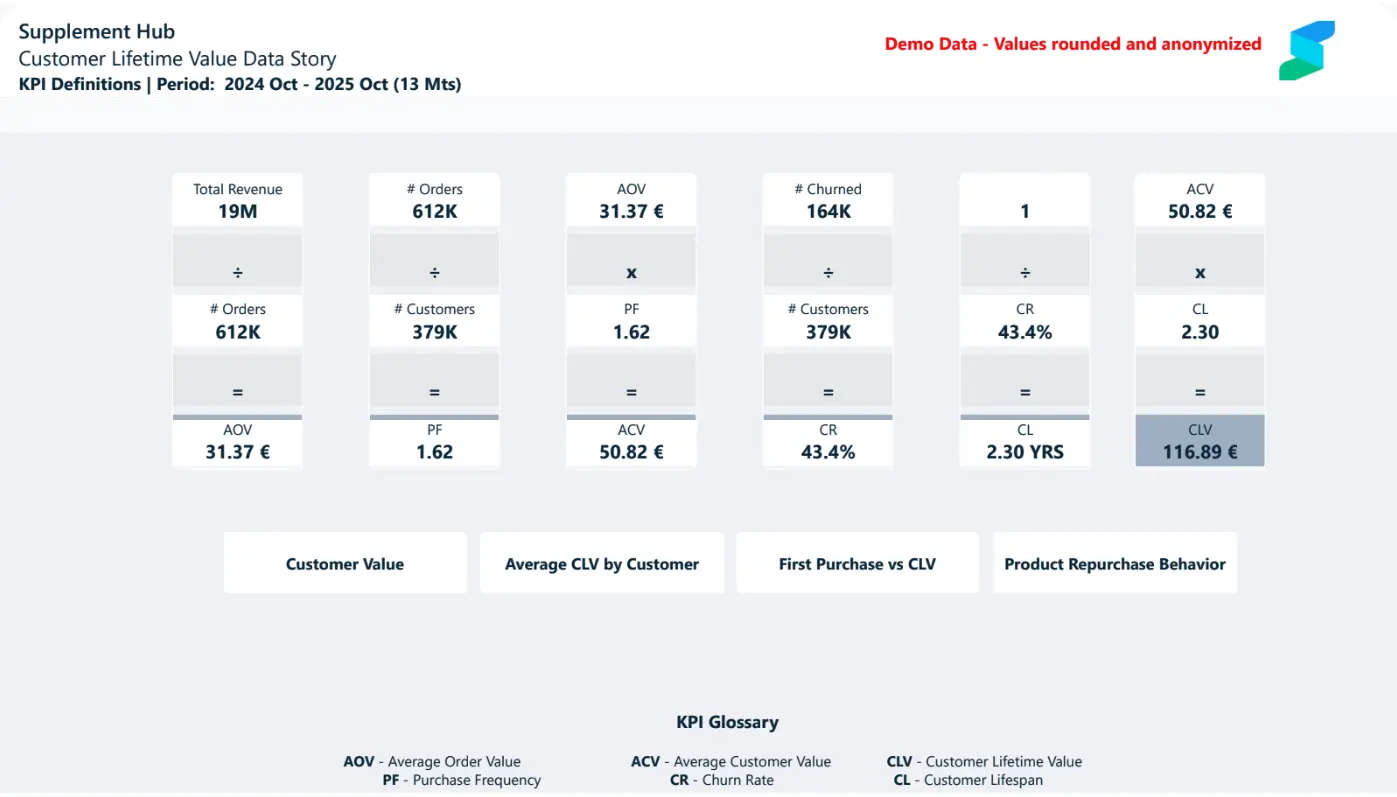
- KPI Definitions view showing how CLV is calculated from its component metrics (AOV, Purchase Frequency, Churn Rate, Customer Lifespan)
- Customer Value by Segment view breaking down CLV by product category to reveal which customer segments drive the most long-term value
- First Purchase Analysis view mapping how initial product choices correlate with lifetime customer value
- Repurchase Behavior view showing patterns in what customers buy after their first purchase
D: Develop
Building the analytics efficiently, guided by prior clarity.
With clear questions and approved design in hand, development moved efficiently. The semantic model was built to calculate CLV and its component metrics with proper business logic embedded at the foundation level.
The 13-month analysis period (October 2024 to October 2025) provided enough data depth to establish reliable patterns while remaining current enough to inform immediate decisions.
E: Embed
Integrating insights into workflows so decisions are made differently.
The final data story was designed to answer the specific business questions identified in the Clarify phase, providing Supplement Hub with a reusable framework for understanding customer value.
The Results
CLV Baseline Established: €111.27
For the first time, Supplement Hub had a clear, defensible Customer Lifetime Value figure calculated from 13 months of actual customer data (October 2024 to October 2025):
Component Metrics:
- Average Order Value: €27.25
- Purchase Frequency: 1.73 orders per customer
- Churn Rate: 42.5%
- Customer Lifespan: 2.35 years
- Total Customers Analyzed: 440,859
- Total Revenue Analyzed: €20.8M
Collagen Category Drives Highest Value
The analysis revealed significant variation in CLV across product categories:
Collagen Category Performance:
- CLV: €175.10 (57% higher than average)
- Revenue: €13.0M (62.5% of total)
- Customers: 213,989 (48.5% of customer base)
- Churn Rate: 34.8% (lowest across all categories)
Other Category CLV:
- Vitamins & Vital Substances: €73.40
- Amino Acids: €57.80
- Protein and Protein Shakes: €74.30
- Nut Butters & Superfoods: €86.90
- Flavordrops: €17.90
First Purchase Predicts Lifetime Value
The analysis revealed that customers who purchase Collagen products as their first item have a CLV of €206.20, which is 85.3% higher than the overall average of €111.27.
Top First Purchase Products by CLV Impact:
| First Product | Customers | CLV | Variance vs Average |
| WehleSports-Collagen-1kg | 146,170 | €206.20 | +85.3% |
| TE-T62Z-DEPL | 7,612 | €171.80 | +54.4% |
| F1-6MA6-0QAT | 41,133 | €121.00 | +8.7% |
| Wehle-Sports-VITAMIN-C-240Kapseln | 6,585 | €132.00 | +18.7% |
This insight revealed that acquisition strategy should consider not just volume of customers, but which entry products attract higher-value customer segments.
High-Churn Categories Identified
The analysis flagged categories with retention challenges:
Protein and Protein Shakes showed a 64.4% churn rate (highest across all categories), despite decent CLV of €74.30. This suggests potential product-market fit issues or unmet customer needs worth investigating.
Flavordrops showed a 51.9% churn rate with the lowest CLV at €17.90, indicating this category attracts lower-value, less-retained customers.
What This Enabled
Strategic Visibility
Supplement Hub now has clear visibility into:
- Which customer segments generate the most lifetime value
- How first purchase choice predicts future customer worth
- Which categories have retention problems requiring attention
- The actual financial metrics driving their business
Data-Driven Framework
The CLV data story provides a reusable framework for:
- Evaluating customer acquisition decisions
- Assessing product performance beyond immediate revenue
- Identifying category-level opportunities and risks
- Tracking business health over time
Foundation for Growth
With established CLV baselines and segmentation insights, Supplement Hub has the foundation to:
- Optimize marketing spend toward higher-value customer segments
- Address retention challenges in high-churn categories
- Make acquisition decisions based on long-term value, not just transaction volume
- Track the impact of strategic changes on customer lifetime metrics
Conclusion
By transforming a raw Amazon export file into a decision-ready Customer Lifetime Value data story, MultiBase helped Supplement Hub discover that the answers to their most important business questions were already sitting in data they had all along.
The difference wasn’t more data or better tools. It was asking the right questions and designing insights that drive decisions.
The analysis identified 57 potential use cases, prioritized the highest-impact opportunity, and delivered actionable intelligence using MultiBase’s DECIDE framework.