
—BI STRATEGY—
Before you build anything, build the strategy.
Most Business Intelligence projects fail because they start with technology. A BI strategy starts with the decisions your business needs to make, and builds everything from there.
When a BI strategy makes sense
You have data. You probably have dashboards. You might even have a data warehouse. But decisions still get made on gut feel, reconstructed spreadsheets, or whatever someone pulled together the night before the board meeting.
That is not a technology problem. It is a strategy problem.
BI strategy makes sense when:
- Reports exist but nobody trusts them enough to act on them
- Different departments use different numbers for the same thing
- Your team spends more time debating which data is correct than deciding what to do about it
- You have considered a BI investment but the proposals ran to six figures and timelines measured in months
- Your IT department told you BI takes a year. That was true five years ago. It is not true today.
A strategy answers the question everyone skips: which decisions need better information, and in what order?

— WHAT THE STRATEGY COVERS —
What a MultiBase BI strategy delivers
This is not a 100-page document that sits in a drawer.
It is a pragmatic, decision-ready plan built in 2-4 weeks. Here is what it covers:
1
Strategic assessment
Where does your company stand today? What works, what is broken, where is the biggest gap between the data you have and the decisions you need to make?
2
Decision mapping and prioritisation
Which decisions drive your P&L, your operations, your competitive position? We map them, rank them by business impact, and define which ones to solve first. The right starting point builds momentum. The wrong one wastes months.
3
Three decision horizons
Your business makes decisions at three rhythms. The strategy designs for all three:
- Daily (Operational): Production status, logistics, sales pipeline, cash position. The question: what needs attention right now?
- Weekly (Tactical): Resource allocation, pricing, customer escalations, forecast revisions. The question: where do we adjust this week?
- Monthly (Strategic): Margin trends, segment performance, capital investment, board reporting. The question: where is the business heading?
Each horizon gets its own reports, its own cadence, its own audience. All three connect to a single source of truth.
4
Data architecture and data flows
Which systems feed which data? Where are the gaps? What needs to be connected? A practical architecture recommendation, not a theoretical blueprint.
5
Dashboard and report structure
How will dashboards and reports be structured so they drive decisions, not just display numbers? Built around the principle: Overview, Where to Look, Detail. No report sprawl. Guided analysis with clear action points.
6
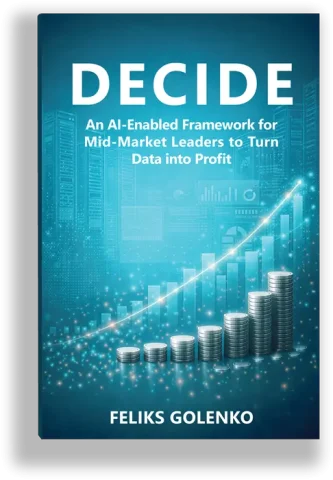
The DECIDE framework as implementation method
Who owns the data? Who maintains the reports? What rules govern data quality and access? A lean governance model that builds trust in the numbers without slowing the business down.
7
Roles, governance, and operating model
Who owns the data? Who maintains the reports? What rules govern data quality and access? A lean governance model that builds trust in the numbers without slowing the business down.
8
Roadmap with milestones
A phased implementation plan. What comes first, what comes next, when are the first dashboards live. No 18-month waterfall. Quick wins first, then scale what works.
— WHAT IT LOOKS LIKE IN PRACTICE —
What you actually receive
At the end of the engagement, your leadership team has:
BI strategy document
(25-30 pages)
The full strategy covering all eight areas above
Executive summary
(8-10 pages)
The version you present to your board or Verwaltungsrat

Use-case backlog with prioritisation
Every identified opportunity, ranked by business impact and feasibility

Roadmap with timeline
Phases, milestones, and a clear sequence from strategy to first live results
Board
presentation
Ready to present, not a draft that needs rework
This is built from real interviews with your decision-makers, real data from your systems, and 35 years of pattern recognition across 400+ mid-market companies. Not a template. Not a generic framework filled with your company name.
— WHY PEOPLE THINK THEY DON'T NEED ONE —
The reasons companies
skip the strategy
We hear these in almost every first conversation:
"We already know what we need."
Maybe. But in 90% of our engagements, the use cases the client thought were most important turned out to be third or fourth on the list once we mapped the actual decision landscape. Starting with the wrong use case wastes months.
"It's going to be a 100-page document nobody reads."
Which decisions drive your P&L, your operations, your competitive position? We map them, rank them by business impact, and define which ones to solve first. The right starting point builds momentum. The wrong one wastes months.
"We just need dashboards, not a strategy."
Dashboards without a strategy is how you end up with 47 reports nobody uses. A strategy ensures every dashboard serves a specific decision made by a specific person at a specific cadence.
"Our IT team can handle it."
Your IT team manages infrastructure. BI strategy requires understanding business decisions, not just data pipelines. These are different skills. We work alongside your IT team, not instead of them.
— PROOF —
What a strategic engagement delivers
1
A EUR 250M European manufacturer ran on disconnected reporting across 14 systems. Monthly board packs took the CFO’s team two full weekends to assemble. Decisions lagged by weeks. Cross-functional alignment happened by accident, not by design.
2
We built a BI strategy using DECIDE. Phase 1 delivered a unified financial reporting layer in five weeks. The CFO walked into the next board meeting with live data instead of a stale slide deck. Phase 2 expanded into production and sales analytics. Phase 3 embedded a decision rhythm across three management layers: daily operational, weekly tactical, monthly strategic.
3
Within six months, the board pack that used to consume weekends generated automatically. The monthly management meeting went from debating whose numbers were right to deciding what to do about them.
— FAQ —
Questions we hear from CFOs considering a BI strategy
How long does a BI strategy take?
The strategy itself: 2-4 weeks. It includes interviews with your key decision-makers, data assessment, and the full strategy document with roadmap. Implementation of the first use case typically starts within weeks of the strategy being approved.
Do we need to replace our existing systems?
No. We work with what you have. Most mid-market companies run SAP, Microsoft Dynamics, Salesforce, or a combination. We connect to your existing systems and build the intelligence layer on top. No rip-and-replace.
What if we already have Power BI but it's not working?
That is Situation 1 for many of our clients. Dashboards exist but nobody uses them. The problem is rarely the tool. The problem is that the tool was set up without a decision strategy behind it. We redesign from the decisions backward.
What does the investment look like
Every engagement is scoped individually. The first conversation is a 30-minute Gameplan Session. We discuss your situation, your data, and what you are trying to achieve. From there, we define the scope and the investment together. There are no standard packages. There are no surprises.
Can we do the strategy and then implement with our own team?
Yes. The strategy stands on its own. Many clients take the roadmap and execute internally. Others choose to continue with MultiBase for the implementation. The strategy document is yours regardless.
Where does the BI strategy sit in the overall process?
The strategy is Step 0. It defines what to build, in what order, and why. Without it, implementation is a gamble. With it, every phase has a defined scope, a clear business case, and a measurable outcome. Think of it as the architectural plan before construction begins.
— THE GAMEPLAN SESSION —
Your dashboards and reports are showing you what happened. They are not showing you where the profit is. That is the problem. And it is solvable.
30 minutes with Feliks Golenko. We work out exactly where to start.